Spanish Empire
A global empire that began with Columbus's 1492 voyage and ended in 1898.

Nagihuin · CC BY-SA 4.0
The Spanish colonization of the Americas began in 1493 on the Caribbean island of Hispaniola (now Haiti and the Dominican Republic) after the initial 1492 voyage of Genoese mariner Christopher Columbus under license from Queen Isabella I of Castile. These overseas territories of the Spanish Empire were under the jurisdiction of the Crown of Castile until the last territory was lost in 1898. Spaniards saw the dense populations of Indigenous peoples as an important economic resource and the territory claimed as potentially producing great wealth for individual Spaniards and the crown. Religion played an important role in the Spanish conquest and incorporation of indigenous peoples, bringing them into the Catholic Church peacefully or by force.
- born
- 1492
- died
- 1898
- field
- Colonial empire
- nationality
- Spanish
- known_for
- First global empire; 'the empire on which the sun never sets'; Magellan–Elcano c
Verified Timeline
Lore & Background
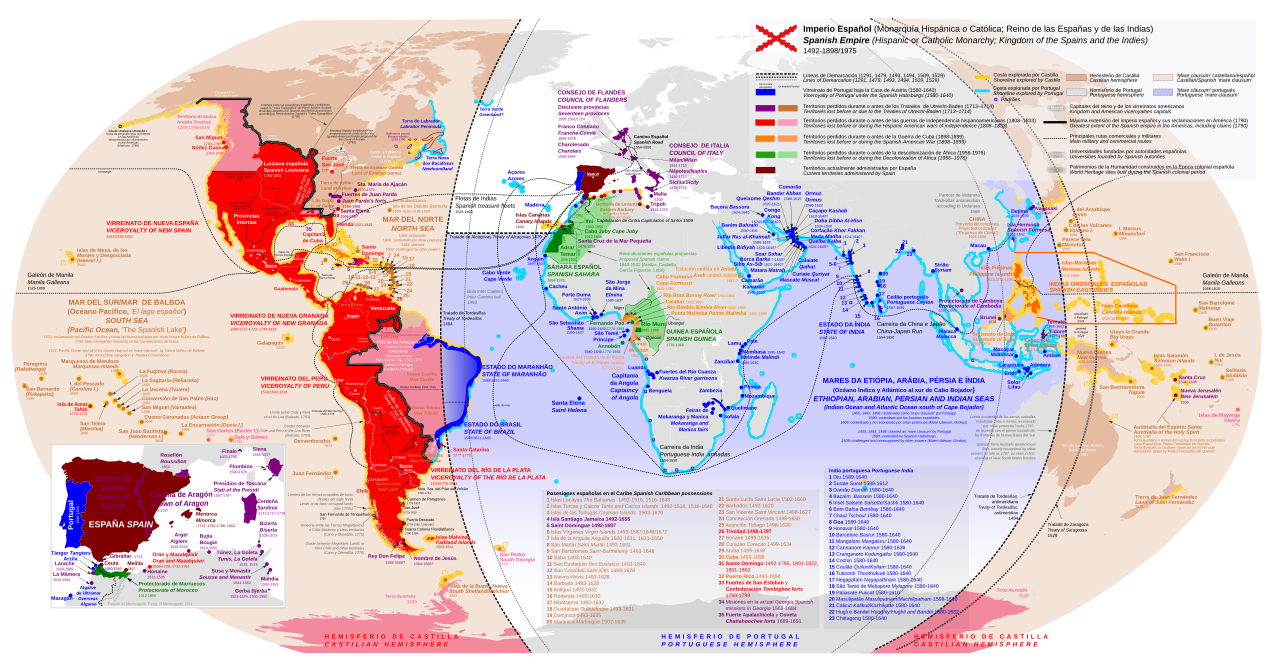
The first expansion of territory was the conquest of the Muslim Emirate of Granada on 1 January 1492, the culmination of the Christian Reconquest of the Iberian Peninsula. On 31 March 1492, the Catholic Monarchs ordered the expulsion of the Jews in Spain who refused to convert to Christianity. Having departed from the port of Palos de la Frontera on 3 August 1492, on 12 October 1492, Genoese mariner Christopher Columbus and his crew made landfall in the Western Hemisphere, and in 1493 permanent Spanish settlement of the Americas began. The deeply pious Isabella saw the expansion of Spain's sovereignty inextricably paired with the evangelization of non-Christian peoples. Pope Alexander VI in a 4 May 1493 papal decree, Inter caetera, divided rights to lands in the Western Hemisphere between Spain and Portugal on the proviso that they spread Christianity. Spain and Portugal formalized a division of the world between them in the 1494 Treaty of Tordesillas. Although during the rule of Charles V, the Spanish Empire was the first to be called 'The empire on which the sun never sets,' under Philip II the permanent colonization of the Philippine Islands made it demonstrably true.
Reader's Guide
The Spanish expansion has sometimes been summed up as motivated by 'gold, glory, God.' Expeditions required authorization by the crown, which laid out the terms. Virtually all expeditions after the Columbus voyages were done at the expense of the leader and its participants. The leader of an expedition, the adelantado, was a senior with material wealth and standing who could persuade the crown to issue a license. Participants supplied their own armor and weapons, and those who had a horse received two shares. For the conquest era, the names of two Spaniards are popularly known: Hernán Cortés, leader of the expedition involved in the conquest of the Aztec Empire, and Francisco Pizarro, leader of the conquest of the Inca in Peru. Spanish conquerors took advantage of indigenous rivalries to forge alliances, most clearly seen in the conquest of the Aztec Empire with the alliance of the Nahua city-state of Tlaxcala. It is estimated that during the period 1492–1832, a total of 1.86 million Spaniards settled in the Americas. The indigenous population plummeted by an estimated 80% in the first century and a half following Columbus's voyages, primarily through the spread of infectious diseases. In the early 19th century, the Spanish American wars of independence resulted in the secession of most of Spanish America. Continuing under crown rule were Cuba and Puerto Rico, along with the Philippines, which were all lost to the United States in 1898, following the Spanish–American War, ending its rule in the Americas.
Did You Know?
- The term 'colonies' was not used for Spanish overseas territories until the second half of the 18th century.
- An estimated 250,000 Spaniards settled in the Americas during the 16th century, with most arriving during the 18th century under the new Bourbon dynasty.
- The indigenous population fell by an estimated 80% in the first century and a half after Columbus's voyages, mainly due to infectious diseases.
- The first Spanish settlement, La Navidad, a crude fort built on Columbus's first voyage in 1492, was abandoned by the time he returned in 1493.
- The Spanish called all indigenous peoples of the Americas 'Indians' (indios) because Columbus was convinced he had reached Asia.
Foundations of a Global Reach
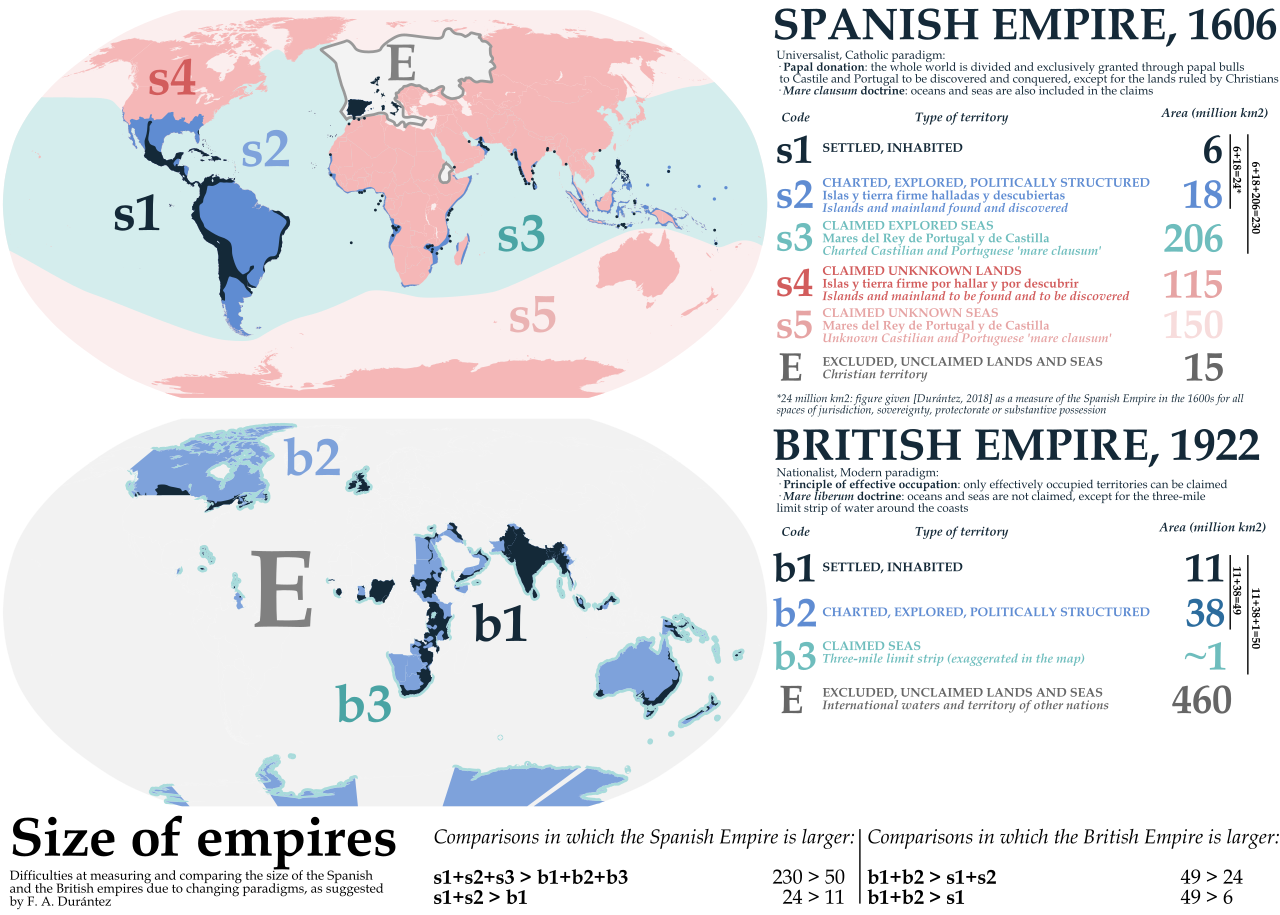
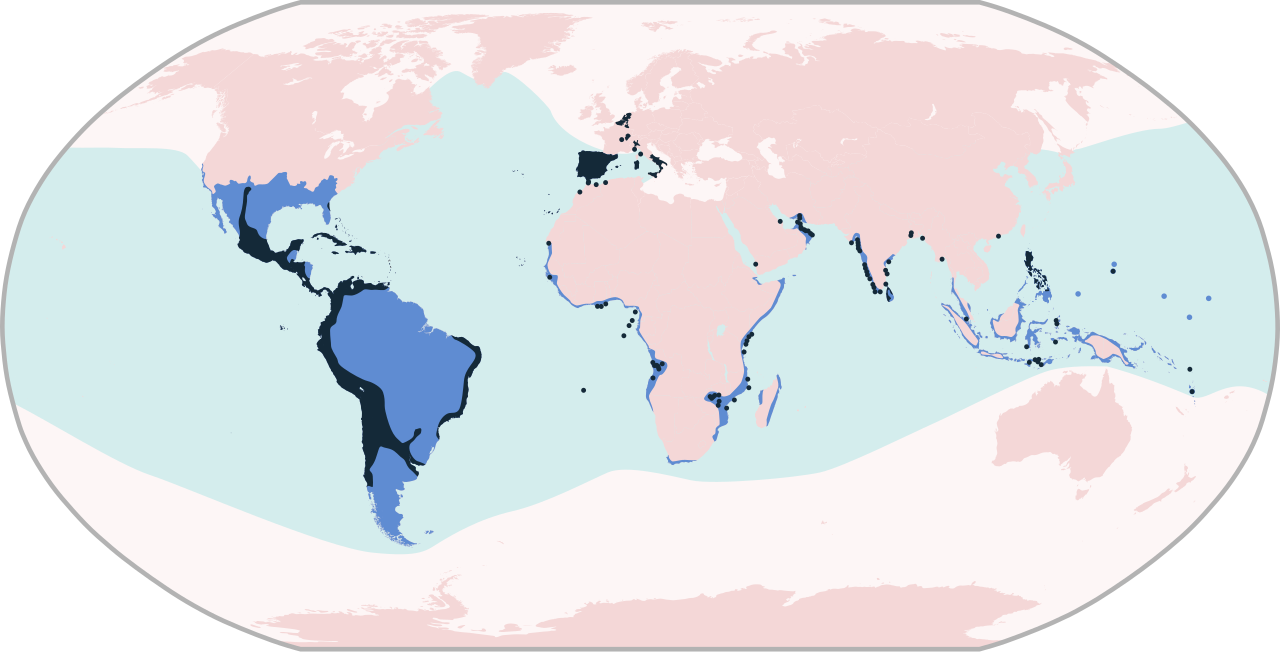
The Spanish Empire's overseas ambitions were set in motion by the joint rule of Isabella I of Castile and Ferdinand II of Aragon, whose marriage unified two kingdoms under a shared expansion policy. Their first major territorial achievement was the fall of Granada in January 1492, ending nearly eight centuries of Muslim presence on the Iberian Peninsula. Months later, they backed the westward voyage of Genoese sailor Christopher Columbus, funded entirely by the Castilian crown. When his crew made landfall in October 1492, the stage was set for permanent settlement on Hispaniola the following year. To prevent conflict with Portugal, which had been pushing down Africa's coast toward India, the two Iberian powers drew a line through the Atlantic in the 1494 Treaty of Tordesillas. Pope Alexander VI had already endorsed this division in his 1493 decree Inter caetera, conditioning it on the spread of Christianity. Yet France, England, and the Dutch Republic simply ignored these arrangements, seizing Caribbean and North American lands Spain had claimed but never effectively populated. Under Charles V the realm earned the nickname the empire on which the sun never sets, and under Philip II the permanent colonization of the Philippines made that phrase literal.
Demographic Upheaval and the Forging of New Peoples
The human cost of Spanish settlement in the Americas was staggering. Between 1492 and 1832, an estimated 1.86 million Spaniards made their way to the New World, with roughly 250,000 arriving in the sixteenth century and the largest waves coming in the eighteenth century, when the new Bourbon dynasty actively encouraged immigration. Another 3.5 million Spaniards followed during the post-independence period from 1850 to 1950. The indigenous peoples, however, suffered a catastrophic demographic collapse. Within the first century and a half after Columbus's voyages, their numbers fell by an estimated 80 percent, driven primarily by the unchecked spread of infectious diseases to which they had no prior exposure. Forced labor systems, slavery for resource extraction, and compulsory resettlement into new villages and later religious missions compounded the devastation. Alarmed by the precipitous population decline and reports of settler exploitation, the crown enacted laws to protect the newly converted indigenous vassals. As indigenous labor sources dwindled, Europeans imported enslaved Africans into the early Caribbean settlements, and both enslaved and free Africans became integral parts of colonial populations. Over time, a mixed-race casta society emerged across the territories under Spanish rule.
Faith, Law, and the Architecture of Control
Religion was not merely a backdrop to Spanish expansion; it was woven into the very machinery of governance. Queen Isabella, deeply pious, regarded the extension of Spanish sovereignty as inseparable from the evangelization of non-Christian peoples, pairing what she called the spiritual conquest with the military one. The crown built both civil and religious administrative structures to manage the vast overseas territories, and the conversion of indigenous populations into the Catholic Church—whether through persuasion or coercion—was a central objective. Settlement patterns reflected this dual logic: Spanish men and women concentrated in areas where dense indigenous communities and extractable resources coexisted. Authority for every expedition of discovery, conquest, and settlement resided in the monarchy, which laid out the terms under which such ventures could proceed. Notably, the word colonies was not applied to these territories until the second half of the eighteenth century, and scholars of Latin America continue to contest the very labels colonization and colonial era, arguing they obscure the complexity of indigenous agency and the diverse political arrangements that existed across the hemisphere.
Independence, Rupture, and the Final Surrender
The early nineteenth century brought a seismic rupture to the Spanish imperial order. The Spanish American wars of independence swept across the continent, resulting in the secession of most of Spanish America and the birth of a string of independent nations. Yet the empire did not vanish overnight. Cuba and Puerto Rico in the Caribbean, along with the Philippines in the far east, remained under the Spanish crown well into the modern era. For centuries, these territories had been the last vestiges of a vast overseas dominion that once stretched from the Caribbean through both American continents. The final chapter came in 1898, when the Spanish-American War stripped Spain of its remaining holdings. The United States took possession of Cuba, Puerto Rico, and the Philippines, and with that loss the Spanish Empire's four-century presence in the Americas came to a definitive close. The territories that had once been administered under the jurisdiction of the Crown of Castile since 1493 were now gone, marking the end of an era that had reshaped the demographics, religions, languages, and political boundaries of an entire hemisphere.
Gallery
Frequently Asked Questions
What is the Spanish Empire in the context of exploration & colonization?
It refers to the colonial empire that ran from 1492 to 1898, originating with Columbus's first transatlantic crossing under the Crown of Castile. It is widely recognized as the first truly global empire, earning the nickname 'the empire on which the sun never sets.'
What were the Spanish Empire's main powers and role?
The empire operated as a vast colonial network governed by Castile, extracting mineral and agricultural wealth from the Americas while actively spreading Catholicism. It simultaneously held territories across the Caribbean, the mainland Americas, and parts of Asia under one political banner.
How does the Spanish Empire's story end?
The final overseas territories were lost in 1898, closing out nearly four hundred years of Spanish colonial rule that had begun with Columbus's 1492 voyage. That date marks the effective end of the empire's global footprint.
Why is the Spanish Empire considered so important?
It set the template for how European nations would approach overseas expansion, combining economic extraction with religious conversion on a worldwide scale. Its early encounters with dense Indigenous populations in the Caribbean also established patterns of exploitation and cultural disruption that echoed through the rest of the colonial era.
Who are the most notable figures tied to the Spanish Empire?
Christopher Columbus launched the empire's founding 1492 voyage, and later the Magellan–Elcano expedition completed the first circumnavigation of the globe under the Spanish flag. Together they anchor the empire's legacy as a pioneer of global seafaring exploration.
More in Exploration & Colonization 1-15
Related in Exploration & Colonization
Links follow this subject's own source article.
Spotted an error? Know more?
This is a living reference — every entry is fact-audited, and reader corrections feed straight into our audit queue. Suggest an edit · See this site's audit record